

In 1986, seven years after the groundbreaking Alien, director James Cameron released its long-awaited sequel. Rather then trying to recreate Ridley Scott’s claustrophobic 1979 horror, Cameron transformed it into something bigger, louder and more militaristic.
Forty years later, Aliens remains one of the rare sequels that can credibly stand alongside – and perhaps even surpass – its predecessor. A friendly argument among friends might debate which sequels are better than the originals. The Godfather Part II, The Empire Strikes Back and Terminator 2 are usually among the contenders. Aliens can be added to that list.
How could the chestburster scene be topped, you might wonder. Well, it wasn’t, and Cameron didn’t try. He made his film stand out by changing its genre from horror in space to war in space, and its look from low-grade industrial to high-tech military grade. And where Scott had only one alien, Cameron had a bunch.
Cameron had been reluctant to write a treatment for an Alien sequel because he considered Alien to be a “perfect movie”. He told the studio that instead of duplicating the original, he would create a “stylistic hybrid” between Alien and The Terminator. The result cemented his rise as a blockbuster director and the reputation of its producer, Gale Anne Hurd.
Picking up 57 years after the events of the first film, Aliens brought Sigourney Weaver back as Ripley. But she was no longer simply the resourceful survivor of Alien. Cameron turned her into an action hero.
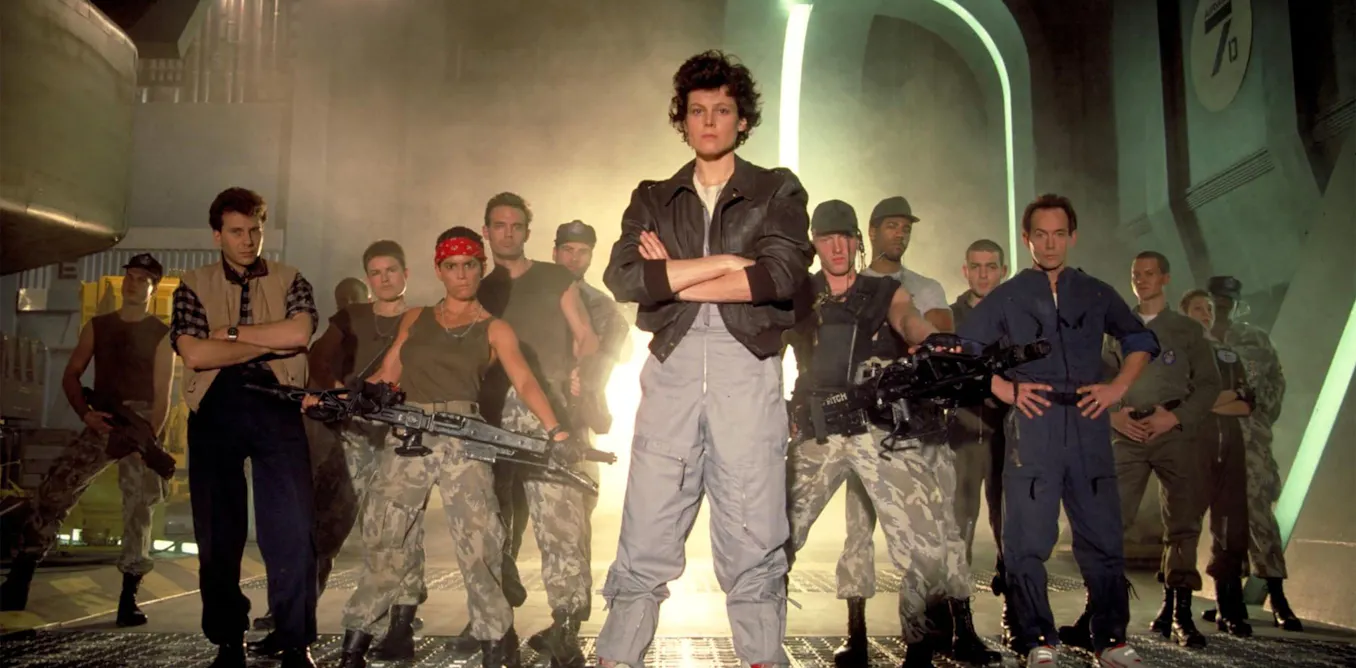
Ripley is surrounded by a fictional interstellar military corps called the Colonial Marines, including both men and women, providing the model for movies like Starship Troopers (1997). One of my favourite exchanges in the film is when the male Private Hudson asks his female colleague, “Hey Vasquez, have you ever been mistaken for a man?” and she replies, “No. Have you?”
The joke captures something important about Cameron’s vision. The women are not simply victims or romantic interests. They are soldiers, technicians and survivors.
Like the “final girl” trope of the horror genre, Ripley survives while others are killed around her. But Cameron takes the idea much further. She protects the young survivor Newt, fights alongside Corporal Hicks and the synthetic android Bishop, and confronts the alien queen. She eventually blasts the queen into space while delivering the film’s most memorable line: “Get away from her, you bitch.”
Like its predecessor, Aliens is full of anxiety about sex, reproduction, motherhood and technology. The alien also taps into anxiety about the vagina dentata, a Latin phrase meaning “toothed vagina”, whereby female genitalia contain teeth. It’s a myth described in many cultures worldwide. The visceral horror of the first movie is maintained.
Like its predecessor, Aliens was another entry into the tech noir subgenre, that reflected on where the human ends and the machine begins. The Alien itself is organic but looks almost metallic, while the synthetic Bishop blurs the distinction between human and machine.
The real enemy
Yet the film suggests that the role of the real enemy belongs to the corporation. The Weyland-Yutani Corporation treats human lives as expendable in pursuit of profit. Its representative, Carter Burke, is willing to sacrifice the surviving humans so that the alien can be brought back to Earth for study. As Ripley tells him: “I don’t know which species is worse. You don’t see them fucking each other over for a goddamn percentage.”
That line still rings true 40 years later. Weyland-Yutani is fictional, but its pursuit of profit at almost any cost remains recognisable.
The political context is important too. In the seven years since Alien, when Democrat Jimmy Carter was president, the US was led by Ronald Reagan. His administration was dominated by free-market capitalism, deregulation, the Strategic Defence Initiative and projecting American power abroad after the Vietnam war, explaining why Cameron put the marines into space. Here, colonialism is not a dirty word.
The Reagan era wanted an image of hard-bodied American hyper-masculinity, as exemplified by Sylvester Stallone as Rambo. By having a woman defeat the aliens where the men could not, Cameron effectively made Ripley into a female Rambo. Ripley succeeds where the marines fail because she understands the enemy and, crucially, has something to protect.
Read more:
Aliens at 40: from wearable cameras to exoskeletons, here are the technologies the film predicted
That may explain why Aliens has endured. It is not simply one of the great science fiction films of the 1980s but of all time. Its anxiety about technology, artificial intelligence, corporations, militarism and the boundaries between human and machine remain remarkably familiar.
Cameron understood that a successful sequel did not mean making Alien again. And by extending the Alien universe, Aliens spawned a franchise that now totals seven official movies. He took the original’s fears and transformed them into something bigger and more action packed, without losing sight of what made them frightening in the first place.
The post “How Aliens became the rare sequel that was as good as – or better than – the original” by Nathan Abrams, Professor of Film Studies, Bangor University was published on 08/26/2026 by theconversation.com