

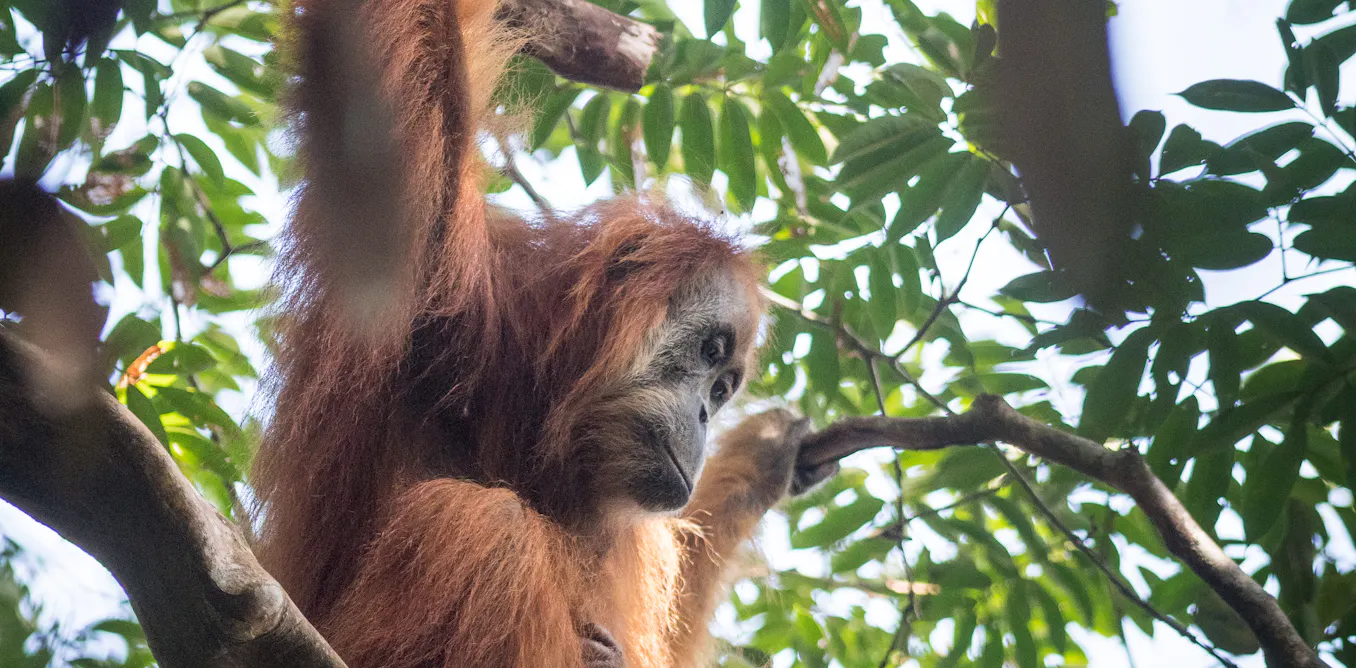
Deep in the forests of North Sumatra, Indonesia, lives the Tapanuli orangutan (Pongo tapanuliensis), the world’s rarest great ape. Fewer than 800 individuals remain, confined to the Batang Toru ecosystem, a landscape that is also home to other rare species like Sumatran tigers, Sunda pangolins, agile gibbons and helmeted hornbills.
For years, debates about the future of Batang Toru have largely focused on major development projects, particularly hydropower, gold mining and geothermal energy. But our new research, published in Biological Conservation, suggests that the story is more complicated.
We tracked forest loss and the human activities driving it by combining three approaches. First, we used satellite data to see where forest had been lost and what was driving that loss. Second, we spoke with local communities to validate our spatial observations and determine the drivers from a local perspective. Finally, we utilised an impact evaluation approach called the synthetic control method. This technique created an artificial twin of the forest to show what would have happened if extractive industries had never arrived in Batang Toru.
By combining these three methods, we examined the locations of forest loss, the social and economic processes driving it, and its additional impacts on the ecosystem. The results reveal that there is no single threat to the Tapanuli orangutan. Instead, multiple pressures are acting simultaneously — ranging from extractive industries and logging to agricultural expansion and, increasingly, climate-related disasters.
Read more:
How we discovered a new species of orangutan in northern Sumatra
Forest loss accelerated after 2012
Between 2000 and 2023, Batang Toru lost 7,659 hectares of forest, equivalent to about 5% of its total forest cover. Forest loss accelerated sharply after 2012, around the time three major extractive projects were initiated in the region.
Using the synthetic control method, we estimated that Batang Toru lost approximately 3,472 hectares more forest than would have been expected in the absence of these projects. This suggests that large-scale developments altered the trajectory of forest loss across the landscape.
However, the direct footprint of extractive industries tells only part of the story.
Our spatial analysis shows that around 70% of total forest loss was associated with small-scale agriculture and logging. While extractive industries caused a surge in forest loss, agricultural expansion and timber extraction have persisted and even increased over time.

This does not mean industrial developments are unimportant. Rather, it highlights that different drivers operate on different timescales. Large infrastructure projects can trigger abrupt changes, whereas agricultural expansion and logging exert a slower but continuous pressure that gradually fragments the habitat.
Looking beyond satellite images
Understanding why forests disappear requires more than mapping where trees are lost. Satellite imagery can show when and where deforestation occurs but often cannot explain the complex social and economic forces behind land-use change.
To address this, we collaborated with the Indonesian NGO Tangguh Hutan Khatulistiwa (TAHUKAH), with support from the Sumatran Orangutan Society (SOS) — having partnered to implement conservation programmes in Batang Toru since 2021. They conducted participant observation, interviews and group discussions with communities living around Batang Toru.
These ethnographically informed conservation methods revealed how changing commodity prices, shifting land tenure arrangements, road development and local livelihood strategies shape land-use decisions.
For example, the drop in rubber prices has led residents to clear rubber plantations to make way for banana crops. Such unregulated land conversions can arise due to overlapping claims to customary and state-owned land, as well as weak oversight of small-scale logging activities.
Together, these findings demonstrate the importance of integrating social and ecological perspectives. This approach is particularly critical because local communities and Tapanuli orangutans have coexisted in the same habitat for generations. Conservation problems are ultimately human problems as much as environmental ones.
Climate change is adding a new threat
As if these long-standing pressures were not enough, Batang Toru is now facing a new challenge.
In late 2025, Tropical Cyclone Senyar brought intense rainfall to Sumatra, triggering widespread flooding and landslides.
Recent estimates suggest that an estimated 8,300 hectares of intact forest were destroyed in the Western Block of Batang Toru alone, potentially resulting in the loss of roughly 58 Tapanuli orangutans — approximately 7% of the species’ global population.
Remarkably, the forest loss caused by this six-day event exceeded the total deforestation recorded across the entire Batang Toru ecosystem between 2000 and 2023.
Preventing extinction means addressing multiple threats
The Tapanuli orangutan is threatened by a combination of extractive industries, agricultural expansion, logging, governance challenges, market forces and climate change.
Addressing only one of these pressures is unlikely to secure the species’ future.
Instead, effective conservation will require integrated approaches that strengthen land tenure security, improve logging monitoring, support sustainable livelihoods and reward communities for maintaining forests.
Private-sector actors also have an important role to play through restoration, biodiversity offsets, and long-term stewardship.
Ultimately, preventing the extinction of the Tapanuli orangutan is about more than protecting a single species. It is about maintaining the resilience of an entire landscape and ensuring that both humans and wildlife can continue to thrive in one of the world’s most biodiverse and imperilled ecosystems.
The post “Multiple threats endanger the world’s rarest great ape, a new study on the Tapanuli orangutan reveals” by Rachakonda Sreekar, Research Fellow, School of the Environment, The University of Queensland, The University of Queensland was published on 08/04/2026 by theconversation.com