

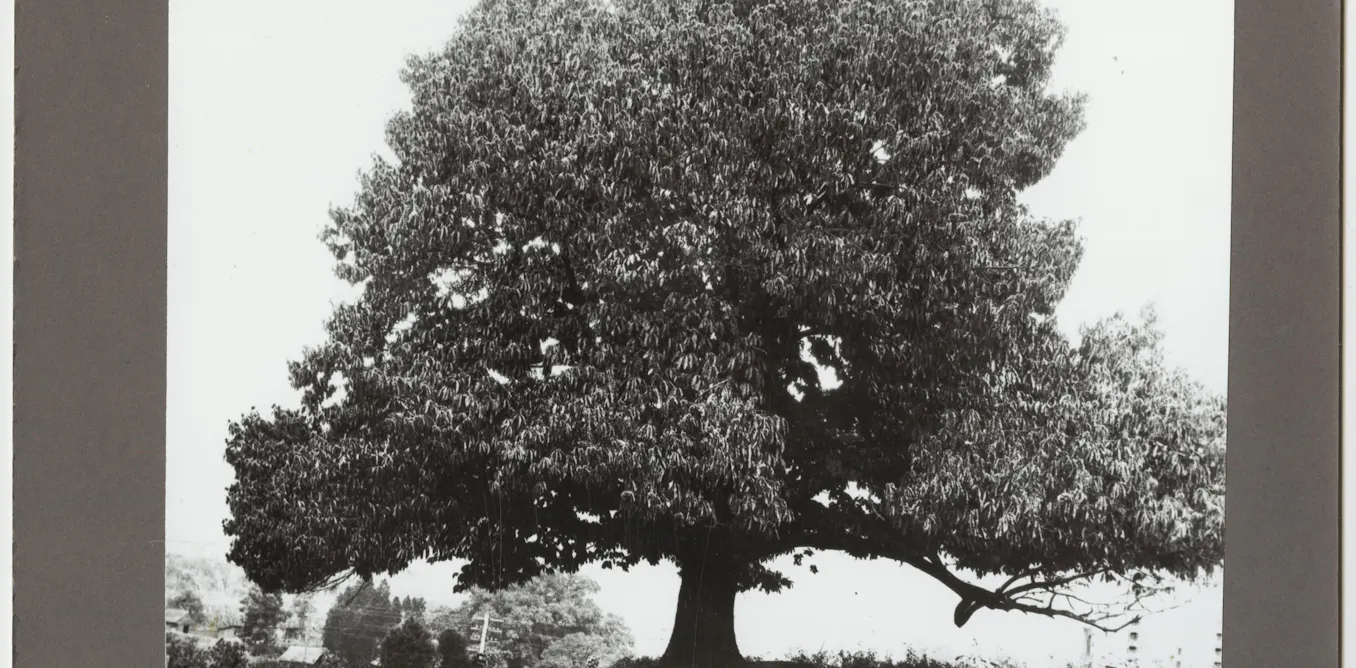
The American chestnut tree was a dominant and iconic species in many Appalachian forests until it was devastated by an introduced fungus from Asia called chestnut blight.
Forest History Society, Durham, N.C.
A majestic forest tree, an American chestnut was typically 50 to 100 feet (15 to 30 meters) in height, but could grow as tall as 150 feet (45 meters) over its several-hundred-year lifespan. Its leafy canopy provided shade and beauty from Maine to Mississippi. The chestnuts it produced had helped to nourish wildlife, Indigenous peoples and European settlers alike. Its rot-resistant wood was also prized for lumber.
People first noticed the blight fungus in New York City in 1904, when it began killing trees at the Bronx Zoo. Over subsequent decades, it spread south and east through the chestnut’s range, killing nearly every mature tree in its path.

Library of Congress Prints & Photographs Division
Chestnut lovers, foresters and scientists – many under the umbrella of the American Chestnut Foundation – have been working for about a century to bring the trees back. The main strategy has been the use of conventional crossbreeding methods to create blight-resistant varieties.
Resistance is exceedingly rare in the American chestnut itself. So breeders have relied on hybridization, crossing the American chestnut with the naturally resistant Asian chestnut by putting pollen from one into the flowers of the other. They recross the hybrids with American chestnut and pick out offspring that are blight-resistant and look like American chestnuts in growth and form. However, progress had been limited.
More recently, scientists have learned more about the tree’s genome – its complete set of DNA – including how its genes are expressed, interact and give rise to traits. Now, researchers are turning to genome science for new strategies for chestnut restoration.
I am a forest biotechnologist who has been studying and teaching about the genetics and engineering of forest trees and other plants for more than 40 years. My laboratory has been using genomic methods, and developing gene transfer and editing methods, for a variety of tree species, including the American chestnut. Our goal is to develop improved genetic transformation techniques to facilitate the restoration of American chestnuts to their dominant role in Eastern forests.
OXO excites, then disappoints
The first major genetic engineering approach focused on inserting a single gene from bread wheat into the American chestnut. This gene encodes a protein called OXO, short for oxalate oxidase, which breaks down oxalic acid, the fungus’s key weapon for invading and killing plant tissues.
For about 20 years, it appeared the OXO gene could produce fully blight-resistant and healthy chestnuts. This work was pioneered by the late William Powell and his colleagues in the College of Environmental Science and Forestry at the State University of New York in Syracuse.
Unfortunately, recent field results suggest that this approach is not working as well as hoped. Many of the trees with the OXO gene unexpectedly developed large abnormal growths called galls, grew slower and showed other symptoms of poor health. Although work to expand and refine the OXO approach continues, new methods and insights from the ongoing genomics revolution in biology have provided new options.
Genomics is helping in two distinct ways
Scientists using genome-guided breeding can rapidly identify thousands of DNA segments that, when used together, can predict blight resistance in young, healthy plants. Then researchers can choose individual trees for making crosses, and for field testing, that have genomes that contain those same DNA segments.
This method enables much faster breeding progress, as breeders can quickly zero in on the best parent trees and progeny, rather than waiting five or more years for the baby tree to grow to see how it fares against the blight. By improving the precision of field studies and disease evaluation, it can save time and money.

Rujirat Boonyong/iStock via Getty Images Plus
The second genomic approach, often just called “omics,” focuses not just on DNA segments, but on genes and what they do. The goal is to figure out how the presence or absence of a particular gene, the matching mRNA transcripts or cellular biochemicals that a gene codes for relates to blight resistance.
Scientists have now identified numerous genes and expressed molecules that are statistically associated with blight resistance in Asian chestnuts. These are logical targets for genetic transformation approaches – that is, using genetic engineering methods to modify naturally occurring genes or introduce genes from one organism into another. My lab has been practicing these techniques for many years in poplars, eucalypts, hops and, recently, chestnut.
The goal is to insert genes from Asian chestnuts, or modify American chestnut genes to act more like those in Asian chestnuts. Genomics-informed studies have been carried on in a modest way for some time, but they are poised to expand rapidly given all the new genomics-informed leads now in hand, together with highly efficient gene-editing technologies like CRISPR.
There are also some surviving large American chestnuts, some of which have heritable blight resistance. Genomic studies of these rare survivors can provide additional insight into the critical genes and processes keeping them healthy, potentially informing both genome-guided breeding and transformation approaches.

Steven Strauss
Challenges beyond the science
From a scientific viewpoint, genomics-guided breeding and genetic transformation approaches are complementary technologies. The former integrates easily into conventional breeding because it’s just another way to choose parents for crossing and field testing. Transformation approaches enable researchers to create or refine novel mechanisms that are not easily accessible by simple breeding. In practice, however, both tactics add significant costs to conventional breeding.
To make matters worse, transformation approaches also face two additional noneconomic barriers to adoption. First, for reasons scientists don’t yet understand, chestnut remains technically challenging to genetically transform. It is often hard to insert genes into chestnut cells; and even once the DNA is in cells, it can be very difficult to get those modified cells to develop into normal plants.
Another limiting factor is that most previous transformation approaches have relied on tissues from developing seeds that are only available during limited times of the year and require very specialized culturing methods. My lab is currently working on a new and hopefully more efficient approach that we hope will mitigate this bottleneck.

Lauren Petracca/The Washington Post via Getty Images
Genetic transformation approaches also face major social barriers in the form of government regulations. Though any kind of chestnut hybrid can be grown in the field freely, those produced with most transformation methods – even when using chestnut genes as the “active ingredients” – cannot.
Transformation-modified trees require strict containment and federal inspections during field studies. Pollen or seed movement – which are very difficult to restrict from mature trees – would violate federal guidelines. Limits on field trials are likely one of the reasons that the problems with OXO were not revealed for many years.
The Agriculture Department has recently begun considering regulatory changes that I hope lead to regulations more in line with consensus scientific advice about genetically engineered crops; these should ease the burdens of conducting field tests. But similar moves over past decades have failed or been reversed due to legal challenges.
Market restrictions also come into play. All the major green certifiers, such as the Forest Stewardship Council, do not allow any materials that result from transformation approaches in certified forest products. These prohibitions on gene editing and transfer reduce the land area where trees created with transformation approaches could be grown, and dampen interest in associated research.
As a scientist, I hope that the barriers to transformation approaches for chestnut, which also apply to the many other forest trees under threat from exotic pathogens and climate stresses, fade. Genomic methods in all their forms have the potential to help protect and restore forests.
The post “New genetic approaches raise hopes for restoring the American chestnut to its former glory” by Steve Strauss, University Distinguished Professor of Forest Biotechnology, Oregon State University was published on 07/22/2026 by theconversation.com