

Calls for a dedicated UK national wildfire service are growing louder. Given the huge recent fires across the country, this is an understandable reaction – people see specialist aircraft used in Spain, Portugal and Greece and want the UK to have something similar.
Sudden climatic stresses are increasing periods of prolonged heat, drought and dry vegetation, creating conditions that make larger and faster-moving wildfires more likely.
So, a specialist national wildfire service for the UK deserves serious consideration. However, aircraft, helicopters and highly trained firefighters alone will not solve Britain’s growing wildfire challenge.
International experience consistently shows that some of the most effective wildfire risk reduction happens long before the first emergency call is made. Places with established preparedness programmes experience fewer accidental ignitions, detect fires earlier, and evacuate people more effectively.
The UK therefore needs to complement any future national wildfire service with a comprehensive community-based programme.
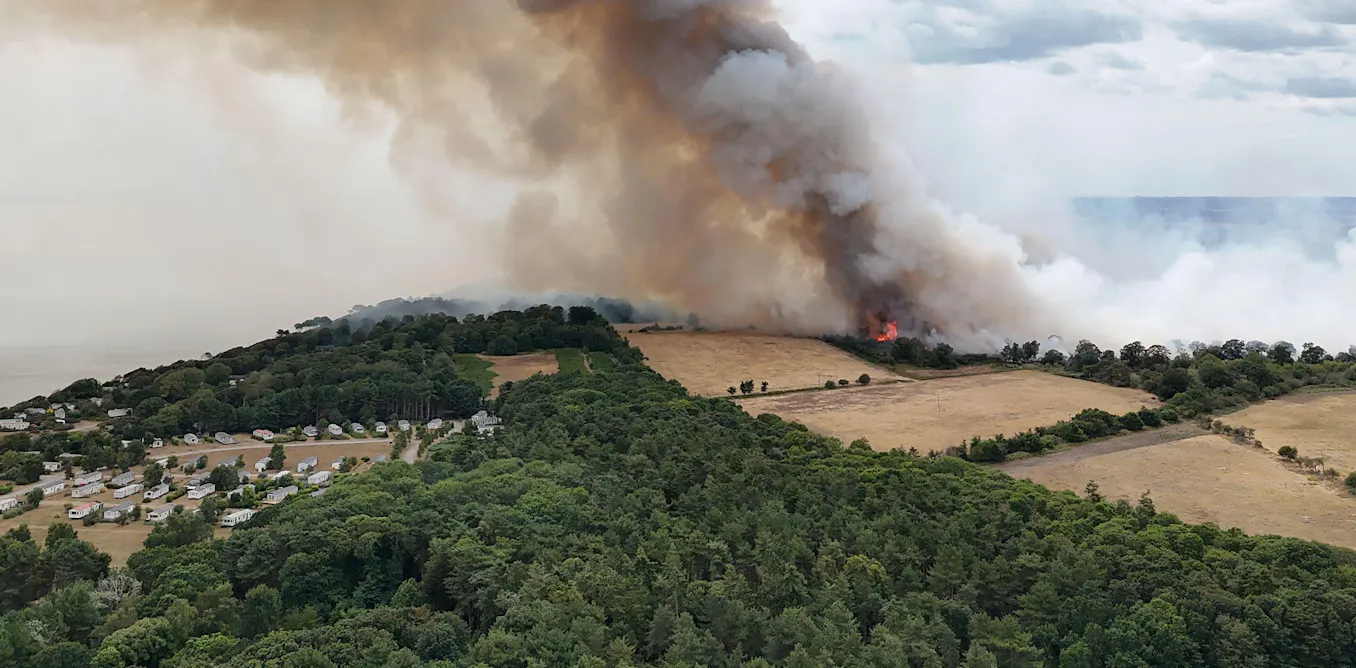
This approach is becoming increasingly relevant in Britain. Although the UK does not experience the vast forest fires seen in southern Europe, North America or Australia, fires are happening more often in grasslands, heaths, moors, peatlands and the areas where homes and businesses meet those wilder landscapes.
As the UK’s landscapes become more fire-prone and the risk of accidental ignitions increases, wildfire prevention is becoming as important as emergency response.
Tolga Akmen / EPA
A wildfire-resilient society
Communities are often the first to notice changing conditions, because they know their local landscapes better than anyone. They can identify hazardous actions, report fires early, and support neighbours before the emergency services arrive. This local knowledge can often determine whether a small incident develops into a major disaster.
Countries with significant wildfire experience increasingly integrate communities into their strategies. Australia, Canada, Portugal, Taiwan and the US all invest heavily in public education and local preparedness, alongside professional firefighting capability.
Taiwan provides a particularly useful example of how technology and community awareness can work together.
The Taiwanese Forestry and Nature Conservation Agency combines forest-fire detection sensors with weather data to calculate real-time Fire Weather Index values in different regions. This data is shared publicly and displayed at major entrances to mountainous areas. It can be checked on phones, so people know the local fire danger before entering vulnerable areas.
The UK could adopt something similar. Rather than relying on emergency responses, these systems could help people make better decisions and avoid being near fires in the first place.
Community wildfire partnerships
But technology alone is not enough. The UK should establish what we might call “community wildfire resilience partnerships” in high-risk areas, including regions that have experienced repeated grassland fires.
These partnerships would bring together emergency services, local authorities, land managers, schools, community organisations and local businesses to coordinate fire prevention and preparedness.

Ken Wolter / Alamy
Regular workshops (“wildfire surgeries”) could educate residents about responsible countryside behaviour, vegetation management, property protection, evacuation planning and what to do in an emergency.
Such programmes would also build trust between emergency responders and local communities, while improving understanding of how emerging technologies such as environmental sensors and digital warning systems can help protect lives and livelihoods.
Young people should be at the centre of this long-term strategy. A national education programme could be delivered through schools, scouts and cadets, youth clubs and the Duke of Edinburgh’s Award scheme.
Students could learn about wildfire behaviour, climate change and environmental stewardship, and could take part in practical activities such as community risk mapping, habitat restoration or evacuation planning. This would help develop a generation of citizens who understand both local environmental risks and their role in reducing them.
Faith-based organisations represent another underused resource. They’re often trusted community hubs with extensive volunteer networks that can disseminate messages, support and shelter people during emergencies. They can also mobilise people for awareness campaigns.
Similarly, plant nurseries and garden centres influence what millions of people grow. They can encourage customers to plant native, climate-resilient and less-flammable species.
I’d like community volunteers to receive basic training in wildfire awareness and detection, safe reporting procedures, first aid and post-fire recovery. Their role is not to replace professional firefighters but strengthen prevention, preparedness, public education and community recovery – both before and after incidents occur.
Investing in people, partnerships and prevention alongside specialist firefighting capability is likely to be one of the UK’s most cost-effective long-term investments in wildfire resilience.
Britain may well need more helicopters and specialist wildfirefighters in the years ahead. But if communities become active partners in reducing risk, rather than passive recipients of emergency services, the country will be far better prepared for a future in which wildfires are an increasingly familiar consequence of the changing climate.
The post “Firefighting aircraft aren’t enough – Britain needs to build a wildfire-resilient society that involves everyone” by Komal Raj Aryal, Lecturer in Crisis and Disaster Management , Aston University was published on 08/06/2026 by theconversation.com